Add topic to email alerts
Receive an email when new articles are posted on
Please provide your email address to receive an email when new articles are posted on .

“
data-action=”subscribe”>
Subscribe
We were unable to process your request. Please try again later. If you continue to have this issue please contact customerservice@slackinc.com. Back to Healio
Key takeaways:
No changes in home dialysis or transplant rates were seen in the ESRD Treatment Choices model after 2 years.
The researchers questioned whether the demonstration should continue through 2027.
Financial incentives offered to providers in a CMS payment model have failed to increase home dialysis and kidney transplantation rates in the first 2 years of the demonstration, published findings show.
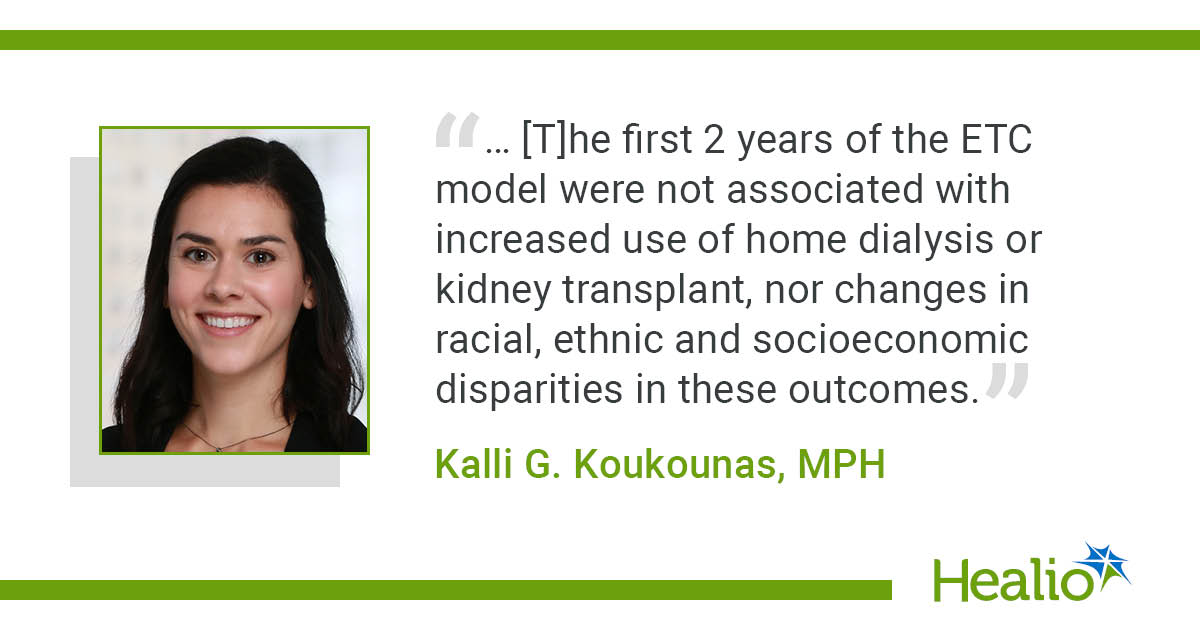
“In this cross-sectional study, the first 2 years of the ETC model were not associated with increased use of home dialysis or kidney transplant, nor changes in racial, ethnic and socioeconomic disparities in these outcomes,” Kalli G. Koukounas, MPH, of the department of health services, policy and practice at Brown University School of Public Health, and colleagues wrote in JAMA Health Forum.
Results of the study lead to questions about the viability of continuing the demonstration, Koukounas and colleagues wrote. “The ETC model is currently set to run through 2027, during which time the payment bonuses and penalties will ultimately escalate to 8% and 10%, respectively,” they wrote. “The disproportionate penalization of facilities serving patients with high social risk and the lack of consistent evidence that the ETC model is improving outcomes raise concerns about the continued implementation of the model as is through its scheduled end date.”
The ETC model, launched on Jan. 1, 2021, randomly assigned approximately 30% of dialysis facilities in the United States to financial incentives aimed at increasing the number of patients on home dialysis or receiving a kidney transplant. A second financial incentive was added in January 2022 to the model for clinics that improved home dialysis and transplant rates among patients with lower socioeconomic status, making the model the first launched by the CMS Innovation Center to directly address health equity.
Healio previously reported that the payment model, managed by the CMS Innovation Center, showed no change in dialysis and transplant rates after the first year, although more patients were trained for home dialysis and evaluated for a kidney transplant.
For this study, Koukounas and colleagues used claims and enrollment data for traditional Medicare beneficiaries with kidney failure from 2017 to 2022. Data were linked to same-period transplant data from the United Network for Organ Sharing.
“The study data spanned 4 years (2017-2020) before the implementation of the ETC model on January 1, 2021, and 2 years (2021-2022) following the model’s implementation,” the researchers wrote. The population included 724,406 patients with kidney failure.
Results showed the percentage of patients receiving home dialysis in the ETC region increased from 12.1% to 14.3% and from 12.9% to 15.1% in control regions, the authors wrote. A similar analysis for transplantation showed no increase compared with controls.
In their study, the researchers questioned the value of using financial incentives to steer patients to specific modality choices. “The ETC model’s limited influence on home dialysis and kidney transplant use in the first 2 years may be attributed to several factors,” they wrote. “First, home dialysis use in the U.S. has been steadily increasing since 2009, likely triggered by that year’s expansion of the prospective payment system. As such, there is an existing financial incentive to increase home dialysis use that extends to all national dialysis facilities.
“Second, the use of home dialysis requires stable housing, as well as the ability to learn and self-administer complex medical regimens, family and caregiver support and the financial resources for potential home modifications and higher utility bills. The application of pay-for-performance incentives to dialysis facilities does not address these patient-level barriers.
“Third, the process of kidney transplant is lengthy, complex and requires several steps from referral to evaluation, wait-listing and ultimately transplant,” the authors wrote. “As such, it may take several years to observe any impact from the ETC model on access to transplant.”
The researchers also wrote that a majority control of the dialysis treatment market by two major providers means that “the payment penalties in one set of facilities may be offset by revenue or bonuses from other facilities owned by the same company.”
Koukounas told Healio that the research offers several suggestions on how to make the ETC model more effective, “the first being to consider providing additional resources, whether that is financial, patient education or other resources, to facilities to help overcome the structural, patient-level barriers that often restrict uptake of home dialysis,” Koukounas said. “This would be particularly useful for safety-net facilities who serve larger proportions of patients with social risk factors, and often lack the resources and/or baseline programmatic infrastructure to support such required changes.”
Koukounas, who worked with the Brown University team to evaluate the first-year results of the ETC model, said the researchers also recommend CMS adjust its health equity definition “to include a broader construct of social risk and/or redefine the social risk stratum cutoff, to prevent the over-penalization of safety net facilities we observed in the model’s first year.
“While the ETC model likely needs more time to observe results, particularly for the transplant outcomes, it appears that thus far financial incentives have not meaningfully moved the needle, and thus there is limited evidence to support the theory that more money devoted to incentives would create meaningful change,” Koukounas told Healio when asked about increasing financial incentives.
Perspective
Back to Top
In this report, Koukounas and colleagues demonstrated that the ETC model resulted in no difference in home dialysis uptake or increase in transplantation between intervention and control regions.
This study comes on the heels of CMS’ own evaluation showing the same result after the first year of the demonstration.
Although many will criticize the agency for launching the ETC model, there is room for hope. The model is one of the first randomized trials run by the agency. Thus, it will yield causal estimates on the efficacy of large financial incentives to nephrologists and dialysis facilities with the intention of increasing the use of home dialysis. Even though it was a null trial, policymakers should avoid the temptation to bury the ETC as a misguided effort. Dissecting and diagnosing why the policy failed will yield insights that could guide future policies.
CMS should address three critical questions about the model. First, policymakers should examine the extent to which exogenous events may have circumvented an otherwise well-designed policy. The ETC model ran alongside the COVID-19 pandemic and the opening of Medicare Advantage to patients with ESRD, two gargantuan events that interacted with the model.
Second, we need to understand whether these policies disproportionately penalized safety-net dialysis facilities and to what extent these disparities were mitigated by the policy’s health equity incentive — a policy innovation in its own right.
Finally, CMS should consider whether future models should undergo a similar randomized design (the 3,522 dialysis facilities participating in the ETC model were randomly selected from 31% of hospital referral regions nationwide). Approximately 100,000 Medicare beneficiaries are part of the ETC model, which required mandatory participation among the dialysis facilities selected.
CMS could learn from academic investigators on optimal trial design, including when or if a trial needs to be ended early for futility, unintended consequences or adverse events.
Recently, CMS announced plans for the Increasing Organ Transplant Access (IOTA) model that also has a randomized design for transplant center participation similar to how dialysis clinics were selected for the ETC model (IOTA will also require mandatory participation).
Hopefully, CMS applies lessons learned from the ETC model to increase its chances of success.
Eugene Lin, MD, MS, FASN
Assistant professor of medicine and health policy & management
Keck School of Medicine
Price School of Public Policy
Division of nephrology
University of Southern California
Los Angeles
Associate editor
Healio | Nephrology News & Issues
Disclosures: Lin reports no relevant financial disclosures.
Published by:
Sources/Disclosures
Source:
Koukounas KG, et al. JAMA Health Forum.2024;doi:10.1001/jamahealthforum.2024.2055.
Disclosures:
The study was supported by grant R01MD017080 from the National Institute of Minority Health and Health Disparities, grant R01HS28285 from the Agency for Healthcare Research and Quality, and grants R01DK113298 and K01DK128384 from the National Institute of Diabetes and Digestive and Kidney Diseases. Koukounas had no relevant disclosures. Please see the study for all other authors’ relevant financial disclosures.
Ask a clinical question and tap into Healio AI’s knowledge base.
PubMed, enrolling/recruiting trials, guidelines
Clinical Guidance, Healio CME, FDA news
Healio’s exclusive daily news coverage of clinical data
Learn more
Add topic to email alerts
Receive an email when new articles are posted on
Please provide your email address to receive an email when new articles are posted on .
“
data-action=”subscribe”>
Subscribe
We were unable to process your request. Please try again later. If you continue to have this issue please contact customerservice@slackinc.com. Back to Healio